Italians are known for craftsmanship, but when you think of their design legacy, it’s unlikely that cuckoo clocks come to mind first. Brothers Ambrogio and Giovanni Pirondini set out to change that with their modern take on the cuckoo clock in the 90s. It’s fair to say that since then, their designs have become recognisable beyond just a small group of cuckoo clock enthusiasts.
The start of the journey for Pirondini
Ambrogio Pirondini set up his first business ‘Arti e Mestieri’ (Arts and Crafts) in 1978. To begin, he made wooden containers for local food producers in Valtellina in the Lombardy region of Northern Italy.
Later, joined by his brother, Giovanni, who studied architecture at the Milan Polytechnic, the company switched its focus to kitchenware and home accessories. This led to successful collaborations with some of Italy’s great designers.
At the start of the 90s, the idea of redesigning the traditional cuckoo clock was conceived. Around this time, Ambrogio and Giovanni decided to use their experience to focus on wooden clock design – and ‘Perodini Italia’ was born.
Collaborations with other designers
Pirondini Italia is renowned for collaborating with other Italian designers. Among them are names like Riccardo Dalisi, Andrea Branzi, and Luca Scacchetti. Branzi and Scacchetti are both alumni of the Polytechnic University of Milan.
One notable collaboration was the Progetti Piccant (pepper grinder) collection from Pirondini. This was the result of working with Maurizio Duranti, an Italian architect and designer born in Florence.
Later, Giovanni Pirondini conceived the idea of a clock collection that would feature the biggest names in 90s design. The collection, known as YET YET YET, was curated by Nanda Vigo and set the course for a new wave of collaborations with Italian designers.
Reimagining the traditional cuckoo clock
Traditional cuckoo clock makers in the Black Forest have been using the same designs and techniques for hundreds of years. Pirondini Italia was one of the first companies to reimage the traditional cuckoo clock.
The Pirondini brothers combined their woodworking experience with their design pedigree to create a modern cuckoo clock that recaptured the interest of the market in the 21st century.
Using traditional and modern tools and techniques, the duo created a workshop that produces precision cuckoo clocks to rival those from the Black Forest. All of the clock mechanisms are made in-house to ensure superior quality.
Modern cuckoo clock design
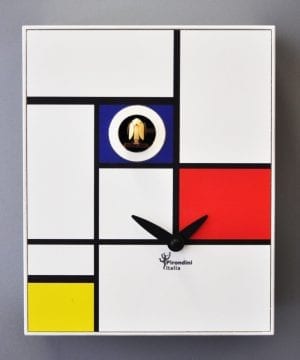
Perhaps the most distinctive clocks from Pirondini Italia combine the cuckoo with reproduction artworks from names like Da Vinci, Miro, Kandinsky, Klimt, and Warhol. There are many more, but we’ll stop at these five.
Pirondini has scores of other clocks. Many use the traditional chalet-style design, but rather than emulating a Swiss or German chalet, these clocks look more like modern houses – some even recreate a high-rise apartment block.
Cuckoo clocks that look like lanterns, bird boxes, and even cable cars sit among the Pirondini collection. The only thing these colourfully eclectic clocks have in common is the cuckoo itself.
Crafts, art, wood, and design
Pirondinin Italia sums up its work in four words – crafts, art, wood, and design.
Their reimagining of the traditional cuckoo clock is a reflection of this. Combining exquisite wooden craftsmanship with brave design, the Pirondini cuckoo clock is a worthy investment.