
The History of Cuckoo Clocks
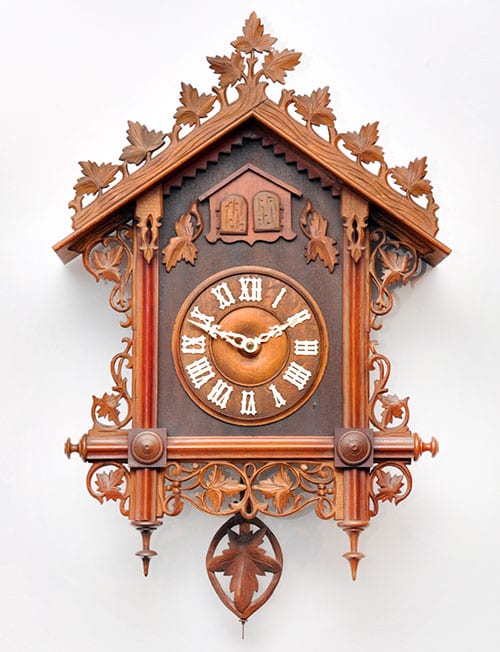
Cuckoo clocks are iconic with their pendulums swinging backwards and forwards to regulate time, periodically puncturing the air with the cry of an automated cuckoo when the hours are struck.
To many of us, cuckoo clocks are simply an item we’re familiar, but have you ever stopped to consider the history of cuckoo clocks? And did you know there are cuckoo clock museums across the world dedicated to celebrating this timeless style of clock?
Who Invented the Cuckoo Clock?
To go back to the beginning and look at the history of cuckoo clocks, we need to travel back to Germany in the 1600s. Cuckoo clock invention is a somewhat contested area with various people describing the mechanism of a cuckoo clock in the years before clockmakers in the Black Forest began producing cuckoo clocks.
Stories abound about the history of cuckoo clocks, and you might be familiar with the legend of cuckoo clock invention that suggests the first one was made in the Black Forest in 1730. The truth is, references to cuckoo clocks and the automated bird cry were part of a handbook way back in 1650, so any attempt to ground its invention in the Black Forest is wishful thinking. Nevertheless, it’s true that the Black Forest played a pivotal role in the development of the cuckoo clock as we know it.


Why is There a Cuckoo in Each Clock?
In the modern world where we have so many objects to help us tell the time from wall clocks to watches through to technological gadgets, it’s difficult to remember that cuckoo clocks played a practical part in alerting people to the passing of time. Think of the interior of the Black Forest, an area dense with trees where light struggled to reach – there’s a good reason why the mechanics of the cuckoo click were refined in this canopied region.
What are Cuckoo Clocks Traditionally Made From?
Most cuckoo clocks, even those built by specialists today, are made from quality wood with carvings and decorations also intricately designed from basic blocks of wood. Traditional Black Forest cuckoo clocks followed a familiar structure, often having a square wooden face which masked all the mechanics of the clock. Above this, an ornate piece of wood contained the door for the cuckoo to emerge from. As time has gone by, different materials have been used to create the mechanical elements, and you can now find more animated birds than ever before thanks to battery powered mechanisms. Yet wooden cuckoo clocks remain the standard, following in the tradition of the Black Forest craftsmen and everyone who has followed in their footsteps.
How Does the Cuckoo Clock Work?
Cuckoo clock invention was predicated on the pendulum regulating the clock and this forms the basis of most modern cuckoo clocks. As for the internal workings of a cuckoo clock, it’s not uncommon for the layperson to be a little confused when asking “how are cuckoo clocks made”, especially when considering their lengthy history and how many of them seem to have intricate workings.
However, it’s more straightforward when you consider the pendulum swinging back and forth evenly with one second covering a full motion of the pendulum. The weighted pendulums are attached to a chain that is itself wrapped around a chain gear, creating a self-propelling mechanism that causes the gears to turn and the weights to descend while making that familiar “tick tock” sound. When the weights have descended to their fullest, they rewind and the whole process starts again.
There are two distinctive cuckoo clock movements, the one-day and eight-day cycles, and they need winding daily and weekly respectively. As you might expect, eight-day cycle cuckoo clocks are more expensive. In both styles, miniature bellows are used to create the distinctive “cuckoo” sound. As the clock moves, the bellows are filled with air and the whistles are created using pipes. All movement of the cuckoo itself in traditional clocks is triggered by the clock’s movement too.
“Chalet” Style Cuckoo Clocks
Generally, cuckoo clocks can be split into two distinctive styles: the traditional and the “chalet” style. One of the distinguishing features of chalet cuckoo clocks is the shape of the top which, surprisingly enough, is modelled on a Swiss chalet and was invented by the Zurich Company Lötscher in Switzerland.
Within this style, you’ll likely find less emphasis on the nature focus of the Black Forest cuckoo clocks. Instead, you might find mill wheels, woodchoppers and bell ringers. These clocks are the ones you’ll often find in souvenir shops, and they definitely fit with the nostalgia many people link to cuckoo clocks, even if they sometimes disregard the nature element.

Modern Day Cuckoo Clocks
Modern quartz movement clocks are battery operated and so function differently to traditional cuckoo clocks. This has led to more versatility, but it also makes it important for buyers to know exactly what they’re getting. There’s nothing wrong with actively choosing a quartz movement clock, but many people looking for a special item for the home will often search for an authentic cuckoo clock, perhaps in the Black Forest style. It’s worth remembering, though, that authentic Black Forest clocks made today must have all their parts derived from that region to be considered genuine.
Modern methods of creating cuckoo clocks can create designs and effects the original craftsmen could hardly dream of, so look out for those unique timepieces floating around too.

Cuckoo Clock Museums: Where to Visit
If reading about the history of cuckoo clocks has left you with a timely urge to discover more of these gorgeous timepieces, there are cuckoo clock museums and exhibitions to help you get your fill. Why not start with the clock room at the British Museum which has an eclectic display of cuckoo clocks and other historic timepieces in one gallery?
There are also some dedicated cuckoo clock museums across Europe including the appointment-only Cuckooland Museum in Cheshire and the Deutsches Uhrenmuseum and Dorf- und Uhrenmuseum Gütenbach in Germany. For those further afield in America, you might be interested in the private collection open to the public in Minneapolis containing over 300 cuckoo clocks but, beware, it might be a noisy trip!
We’ve got a clock style for everyone!


